
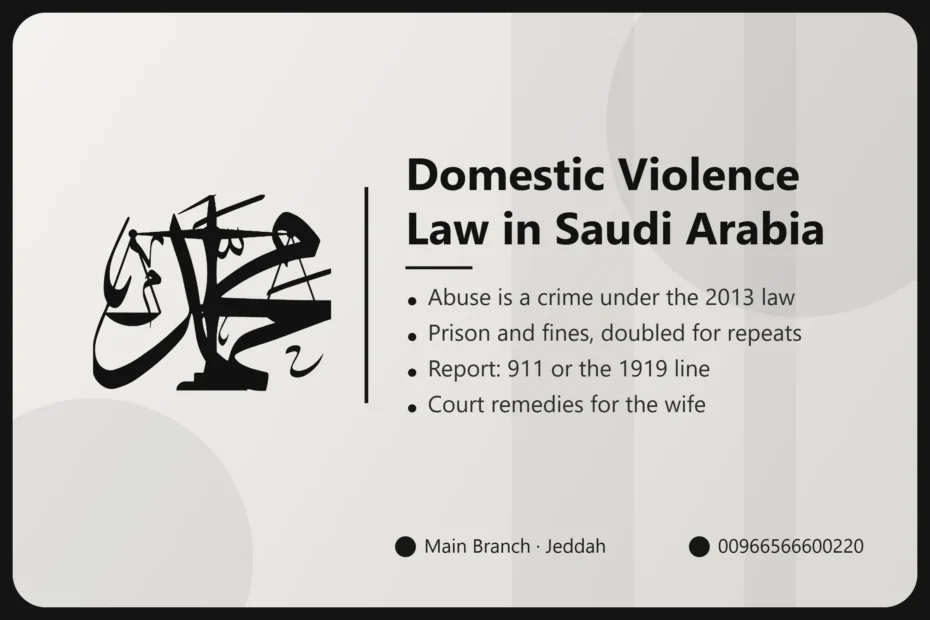
Domestic violence law in Saudi Arabia makes abuse a crime. The Protection from Abuse Law, issued in 2013 and amended in 2022, treats physical, psychological and sexual abuse, threats of abuse, and neglect of a dependant’s basic needs as offences, and it sets prison terms and fines for them. This guide explains what the law covers, the penalties, how to report, and the civil remedies open to a wife who is being harmed.
جدول المحتويات
Quick answer on the domestic violence law in Saudi Arabia
Abuse inside the family can be reported to the police or to the Ministry of Human Resources and Social Development, and anyone who learns of it must report it immediately (Article 3). The basic penalty is imprisonment of one month to one year, a fine of SAR 5,000 to 50,000, or either of the two, and it is doubled for repeat offences. Harsher penalties apply in aggravated cases, and other laws or Sharia rules can add to them. The domestic violence law in Saudi Arabia lets anyone report abuse, not only the victim.
What the domestic violence law in Saudi Arabia treats as abuse
- Physical abuse, from hitting to any act that causes injury or pain.
- Psychological abuse, such as threats, insults, humiliation or isolating someone from family and friends.
- Sexual abuse and exploitation.
- Threats of any of these acts.
- Neglect, meaning failing to provide a dependant’s basic needs when the duty to provide them falls on you.
The law applies to abuse that exceeds the powers and responsibilities a person holds over another through guardianship, dependency, sponsorship or providing a livelihood. Family and household relationships fall within this, and in practice it is used for abuse between spouses. Confirm how the wording applies to your situation with a lawyer.
Penalties under the law
| Situation | Penalty |
|---|---|
| Basic offence | Imprisonment of one month to one year, a fine of SAR 5,000 to 50,000, or either; the court may impose an alternative to imprisonment |
| Aggravated cases, for example the victim is a person with a disability, a parent of the offender, over 60, or a pregnant woman who loses the pregnancy; the abuse happens at a workplace, school or place of worship; the offender is a person charged with enforcing the law; a weapon is used; or several abusive acts occur in the same incident | Imprisonment of one to five years and a fine of SAR 50,000 to 300,000 |
| Repeat offence | The penalty is doubled |
| Helping or inciting the offence | Same penalty as the offender |
These penalties are in addition to any harsher punishment that another law or Sharia rules provide, for example where the abuse causes serious injury.
How to report abuse: 4 steps
- If anyone is in danger, call the emergency number 911.
- Report the abuse to the police or to the social protection line, 1919, run by the Ministry of Human Resources and Social Development.
- Seek medical care and ask for the injury to be documented in a medical report.
- Keep evidence: photos, messages, recordings, and the names of anyone who witnessed the events.
A person who reports in good faith is not held liable if the case later turns out not to be abuse (Article 6), and employees who learn of abuse through their work must pass it on to their employer, who must notify the authorities (Article 3).
What a wife can claim through the family courts
A wife can bring these claims before the personal status court through Najiz, under the Personal Status Law:
- Dissolution of the marriage for harm, if the harm is proven (Article 108). See the difference between the types of divorce in our guide to revocable and irrevocable divorce.
- Maintenance, which covers housing, for herself and the children, including interim maintenance while the case is pending (Articles 45 and 50).
- Custody arrangements that protect the children, based on their interests.
Evidence that helps
- Medical reports and hospital records.
- Police or social protection reports.
- Photos of injuries and of damaged property.
- Messages, voice notes and call logs.
- Statements from witnesses, such as neighbours or relatives.
Keep copies outside the shared home and do not delete anything, even if it feels minor at the time.
Frequently asked questions
Is domestic violence a crime in Saudi Arabia?
Yes. The Protection from Abuse Law criminalises physical, psychological and sexual abuse and threats, and sets prison terms and fines.
What is the penalty for hitting a wife in Saudi Arabia?
The basic penalty under the Protection from Abuse Law is one month to one year in prison, a fine of SAR 5,000 to 50,000, or either. It is doubled for repeat offences and higher in aggravated cases.
Who can report domestic violence?
The victim, a witness, a relative or any authority can report it to the police or the social protection line 1919. Anyone who learns of abuse must report it immediately.
Can a wife ask for divorce because of harm?
Yes. A wife can ask the court to dissolve the marriage for harm under Article 108 of the Personal Status Law, if she can prove the harm with evidence such as medical reports and witnesses.
Do I need a lawyer to report abuse?
No, you can report directly. A lawyer helps if you want to open a court case, claim maintenance, or secure custody and safe housing.
Conclusion
Abuse at home is covered by the domestic violence law in Saudi Arabia, a specific law with prison terms and fines. If you are in danger, report it first and document everything, then speak to a lawyer about the court route that protects you and the children. That is the practical value of the domestic violence law in Saudi Arabia: it turns a private danger into a reportable offence.
Need to protect yourself or a family member in the Eastern Province? Send us a message on WhatsApp and a family lawyer will explain your options. You can also see our personal status lawyer in Dammam page.
Legal content reviewed against official Saudi sources — 16 November 2026.
